Load Balancer
Load balancing occurs when a customer has multiple service providers that offer the same products within a service. The Electrum switch will direct transactions to one or other service provider based on predetermined weighting rules. These rules may be based on commercial agreements or other reasons.
The main purpose of load balancing is to route transactions. Health checking is an additional feature on the load balancer page that provides insights into the health of service providers. Users can use this information to adjust load balancer weights, helping them manage service providers based on whether they are healthy or unhealthy.
Load balancing refers to the switch's ability to direct transactions to a service provider based on an assessment of weightings that determine the proportion of transactions that will be routed to a service provider.
Benefits of Load Balancing
The Electrum Load Balancer:
- Maintains a high level of availability.
- Allows customers to customise the transaction volumes between multiple service providers and provides customers with flexibility.
- Allows manual switching on and off of service providers. This is useful for when a service provider is unavailable. It also allows for the slow ramp up of traffic to a new service provider, lowering the risk of bringing new service providers on board.
- Automatically performs health checks of each provider stream at regular intervals. If one of the provider streams is unavailable or unhealthy then it can redirect transactions to an alternate provider that provides the same product or service. This is known as failover.
Load Balancing at a service provider level
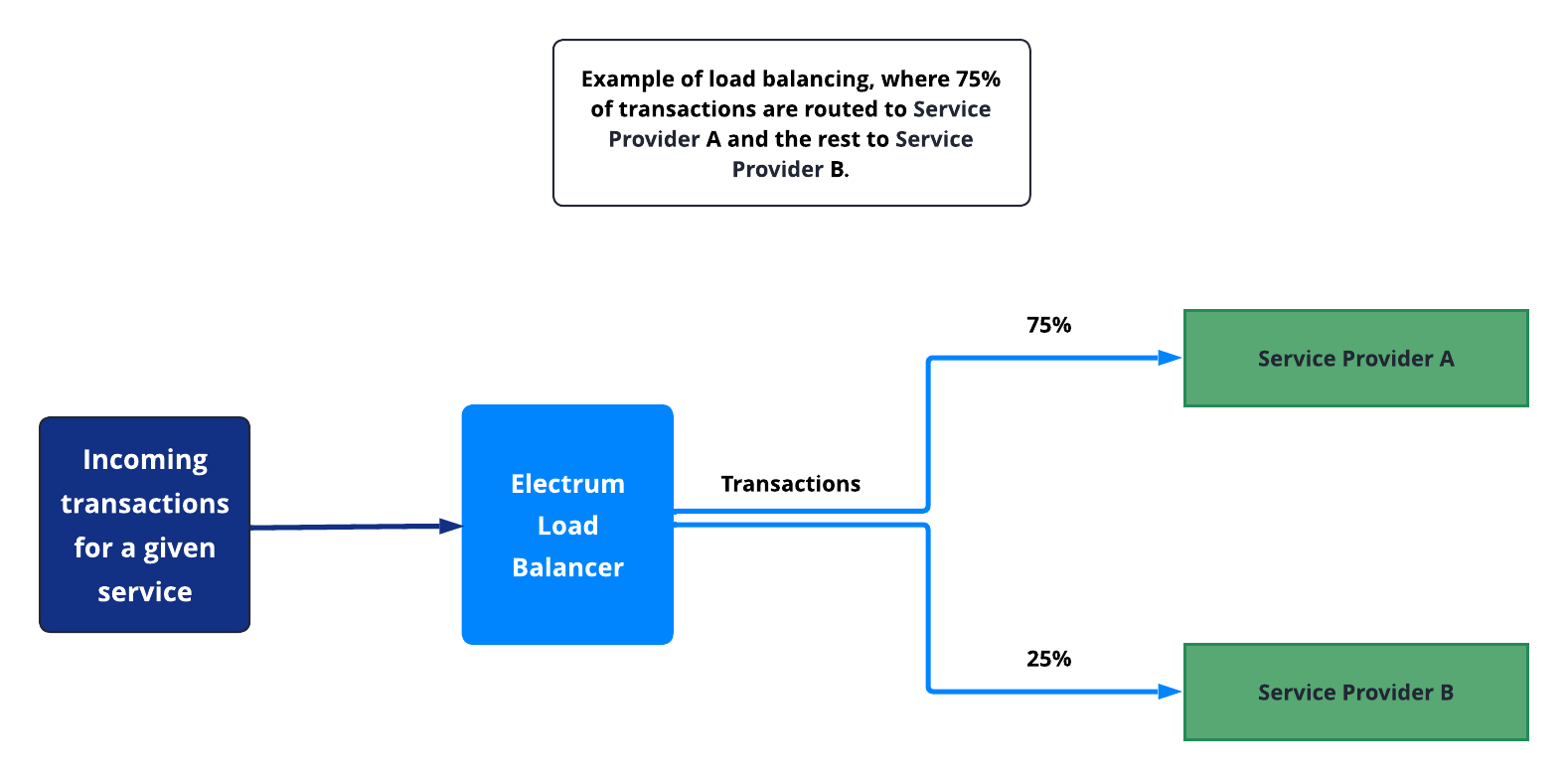
The Electrum Load Balancer allows users to specify how they wish to split traffic between multiple service providers. This is done by specifying a Weight or Default Weight per service, per provider, where weightings are applied proportionately. For example, a user may wish for 75% of transactions to be routed via Service Provider A and the remaining 25% to be routed via Service Provider B. This means that one out of every four transactions will go via Service Provider B. Where a product can be vended by more than one provider (i.e., there are multiple possible routes for a transaction to be routed) and where no other routing strategy is involved (such as preferential routing), the load balancer’s weightings across service providers are used to decide where to route a transaction.
The load balancer incorporates another useful feature whereby customers are able to switch service providers ‘on’ and ‘off’ in the Electrum Console. This is useful in certain circumstances, e.g., during testing or when there is an unhealthy connection. Additionally, customers can adjust the transaction weightings.
Load Balancing at a mobile network operator level
Electrum offers the following load balancing capabilities, and you may use any or all of these depending on your business requirements.
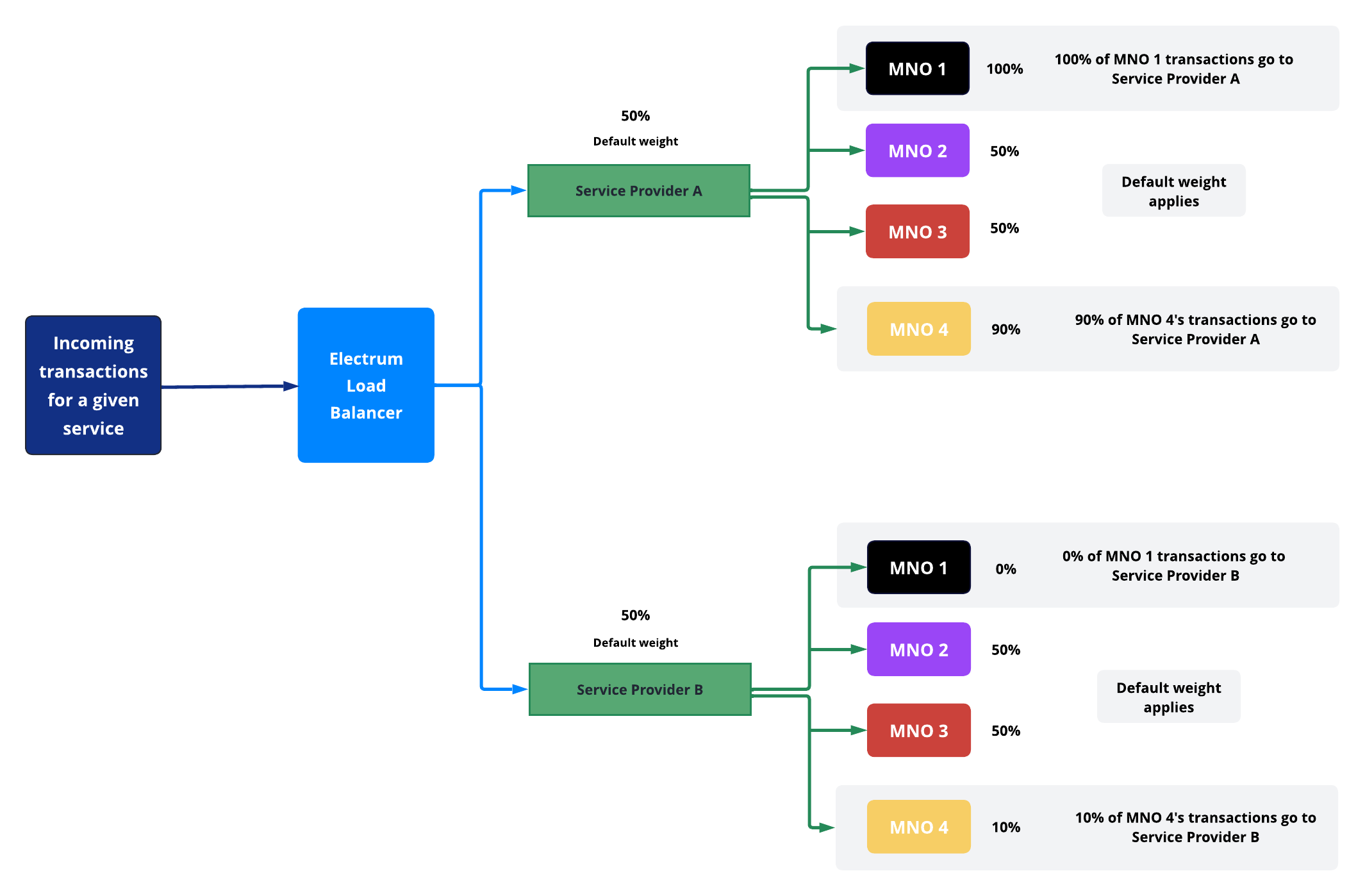
Service provider default weightings - This feature is similar to load balancing at a service provider level. It highlights that it applies to a specific MNO instead of all MNOs. The diagram below illustrates that all transactions intended for a particular MNO should be distributed equally between Service Provider A and Service Provider B. MNO 2 and MNO 3 traffic is routed according to the default weightings.
Overrides - If you want to maintain the overall default weightings but need to adjust the weightings for one or more MNO — for instance, due to a temporary unhealthy service provider (SP) connection or financial agreements — you can implement an override. This can be done in two ways:
Full transaction volume override - In this case, all traffic for an MNO is routed through a preferred service provider, as illustrated with MNO 1 in the diagram below.
Partial transaction volume override - Here, the default weightings are adjusted to be higher or lower. For example, with MNO 4, the default weightings indicate that 50% of all MNO 4 traffic should be routed via Service Provider A and 50% through Service provider B. However, an override rule can be set to route 90% of the traffic through Service Provider A.
In both scenarios, the override only applies to the specific MNO in question. You can apply different override rules for different MNOs. Therefore, while MNO 1 and MNO 4 have distinct override rules, MNOs 2 and 3 adhere to the default weightings.