Receive PayShap with Partner-Auth
This page describes how to receive a PayShap payment for which authorisation by the corporate client is required.
Overview
The payment authorisation step requests that the corporate client verify that a requested payment can be made to a particular proxy.
It is important to note that a successfully authorised (approved) payment does not necessarily mean that the payment is final. The funds may not yet have been applied to the customer's account (or wallet or record) at the time of authorisation. However, after approving a transaction, the corporate client may not revoke the payment. The client will be obliged to make the payment to the customer's account once a completion is sent from BankservAfrica (the scheme operator), unless the payment is subsequently cancelled by BankservAfrica itself.
When participating in authorisation of a payment, the corporate client may take the following into account:
- Whether the account/wallet/record corresponding to the given proxy exists and is valid.
- Whether any payment limits that may be relevant to the client are exceeded or not. Note that Electrum validates that PayShap transaction amounts do not exceed the scheme limit. Hence, this does not need to be validated by the corporate client.
- Whether an invoice linked to the given proxy is still valid or has expired.
The diagram below describes the complete transaction journey for a successful proxy-based PayShap payment that you will receive. The clearing phase consists of payment authorisation and payment finalisation.
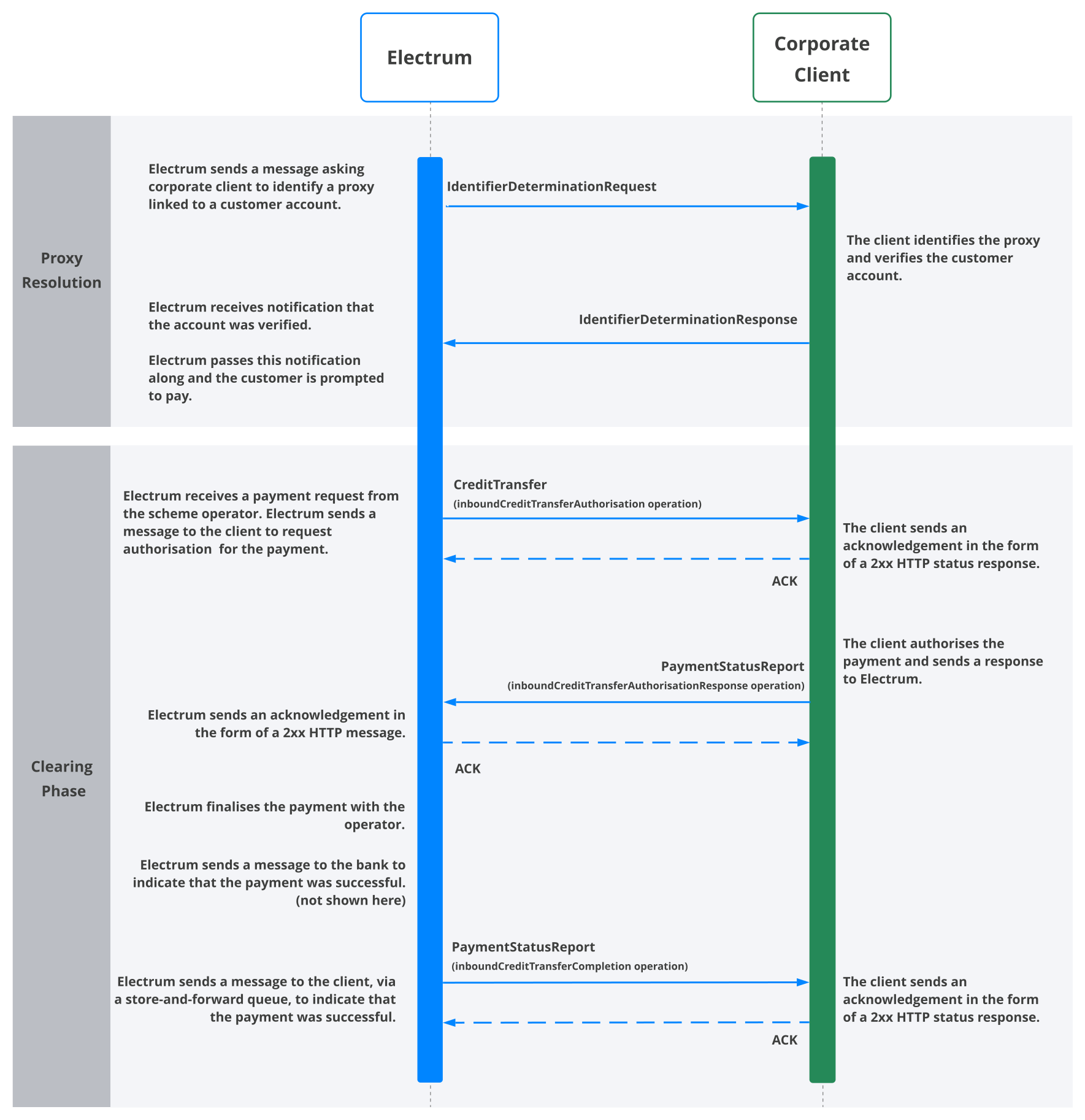
Proxy Resolution
The proxy resolution phase aims to determine that the proxy identifier is valid and returns the details of the associated customer record in your system. The end-user that initiated the payment from their banking app can then confirm the details before initiating a credit transfer to the proxy.
- Electrum sends you an
inboundSynchronousIdentifierDeterminationrequest via the/identifiers/inbound/identifier-determination-syncendpoint (IdentifierDeterminationRequestschema; below).
IdentifierDeterminationRequest Schema
Holds a point-to-point unique message identification string as well as a message's creation date time.
The date and time at which the message was created, in senders local timezone or UTC. The date must be formatted as defined by date-time in RFC3339
A reference used to unambiguously identify the message between the sending and receiving party. Take note that this uniquely identifies a single message in a potentially multi-message exchange to complete a payment.
A list of key-value pairs to support adding any supplementary/additional data to an Electrum Regulated Payments API message.
A request providing information for the lookup of a proxy or account in the context of the ZA RPP Payment Scheme:
- If the identifier schema is either MOBILE or CUSTOM, proxy resolution will be performed. In this case, the
identifier.namespacefield is required. - If the identifier schema is GENERIC, account resolution will be performed. In this case, the
accountAgent.bicfifield is required.
Identifies the scheme used for the payment
ZA_RTC: South African Realtime Clearing scheme.ZA_RPP: South African Realtime Payments Platform scheme.ZA_EFT: South African Electronic Funds Transfer scheme.ZA_AC: South African Authenticated Collections scheme.ZA_RMS: South African Registered Mandate Service scheme.CBPR_PLUS: Cross-Border Payments and Reporting Plus.TCIB: Transactions Cleared on an Immediate Basis scheme.
An identifier's namespace provides a context for the identifier to distinguish different identifiers which may have the same value but be intended to identify different accounts. For example, a bank may use the same MSISDN (identifier) with different namespaces to distinguish between a customer's cheque or savings accounts.
This may be used by the following schemes:
- ZA_RPP
Indicates the schema of the identifier, e.g. MOBILE, CUSTOM.
Universally unique identifier to provide an end-to-end reference. This identifier remains the same for all messages related to the same transaction.
Unique identifier for this specific verification request.
Example
No contentYou identify the customer proxy and verify the related customer record.
You return an
IdentifierDeterminationResponseto Electrum (see schema below).
There are a number of fields in the response message that MUST be populated, even if they are designated as optional in the API. See the table below for a list of these fields and guidelines on how to populate them.
| Field | Guidelines for Populating Field |
|---|---|
report.reportInformation.accountInformation.creationDate | The date on which the account referenced by this proxy identifier was created. |
report.reportInformation.accountInformation.proxy.value | The proxy value. This consists of a string of up to 2048 characters. |
report.reportInformation.accountInformation.proxy.schema | The schema of the identifier.
|
report.reportInformation.accountOwner.knownAsName | This field is included so that it can be verified by the end-user using their banking app.
|
Electrum will populate the report.reportInformation.accountOwner.legalName with the official entity name of the corporate client, as specified by the sponsor bank.
IdentifierDeterminationResponse Schema
Holds a point-to-point unique message identification string as well as a message's creation date time.
The date and time at which the message was created, in senders local timezone or UTC. The date must be formatted as defined by date-time in RFC3339
A reference used to unambiguously identify the message between the sending and receiving party. Take note that this uniquely identifies a single message in a potentially multi-message exchange to complete a payment.
A list of key-value pairs to support adding any supplementary/additional data to an Electrum Regulated Payments API message.
Holds a point-to-point unique message identification string as well as a message's creation date time.
The date and time at which the message was created, in senders local timezone or UTC. The date must be formatted as defined by date-time in RFC3339
A reference used to unambiguously identify the message between the sending and receiving party. Take note that this uniquely identifies a single message in a potentially multi-message exchange to complete a payment.
Identifies the scheme used for the payment
ZA_RTC: South African Realtime Clearing scheme.ZA_RPP: South African Realtime Payments Platform scheme.ZA_EFT: South African Electronic Funds Transfer scheme.ZA_AC: South African Authenticated Collections scheme.ZA_RMS: South African Registered Mandate Service scheme.CBPR_PLUS: Cross-Border Payments and Reporting Plus.TCIB: Transactions Cleared on an Immediate Basis scheme.
Further information related to the proxy resolution response, provided by the Operator, and intended for the creator agent.
The universally unique identifier provided in the original request as an end-to-end reference. This identifier remains the same for all messages related to the same transaction.
The request.verificationIdentification as provided in the original request.
A report providing information from the lookup of a proxy in the context of the ZA RPP Payment Scheme.
This report returns information required to proceed with the clearing of funds through the use of the proxy (identifier) provided in the identifier determination request. Specifically, this report will provide the outcome of the lookup of said identifier, indication whether it is valid or not, as well as provide the name ("known as name") of the creditor, and the legal name of the creditor (both of these are mandatory in the ZA RPP Payment Scheme, despite not being mandatory in this API), namely:
accountOwner.knownAsNameaccountOwner.legalName
This model is the basic representation of a Party. It is expanded on depending on whether the party is a person or an organisation.
AB06: Transaction stopped due to timeout at the Instructed Agent.AB07: Agent of message is not online. Generic usage if it cannot be determined who exactly is not online.AB10: An error occured at the instructed agentAC06: Account specified is blocked, prohibiting posting of transactions against itAG01: Transaction forbidden on this type of accountAG03: Transaction type not supported/authorized on this account.AG10: Agent of message is suspended from the Real Time Payment system. Generic usage if it cannot be determined who exactly is suspended.AGNT: Agent in the payment workflow is incorrectAM02: Specific transaction/message amount is greater than allowed maximum (e.g. payee proxy participant service limit exceededCH21: Mandatory element is missing .DT02: Invalid creation date and time in Group Header (eg, historic date) .DU03: Transaction is not unique.DUPL: Request is a duplicate of another requestFF02: Syntax error reason is provided as narrative information in the additional reason information.FF08: End to End Id missing or invalid .NAUT: Permission to be processed is not grantedNOOR: Original SCT never receivedPD01: Domain not found or invalidPD02: Suspended Domain provided is suspended pending investigationBE23: Phone number or email address, or any other proxy, used as the account proxy is unknown or invalid.PX03: Proxy not found in central repositoryPX04: Format of proxy invalidRC05: BIC identifier is invalid or missing.RC08: ClearingSystemMemberidentifier is invalid or missing. Generic usage if cannot specify between debit or credit account .RR10: Character set supplied not valid for the country and payment type.RR12: Invalid or missing identification required within a particular country or payment type.RF01: Transaction reference is not unique within the message.AC16: Account in SequestrationAC17: Account in LiquidationAC04: Account ClosedAC01: Format of the account number specified is not correctMD07: Account Holder DeceasedNOCM: Customer account is not compliant with regulatory requirements, for example FICA (in South Africa) or any other regulatory requirements which render an account inactive for certain processing.BE01: Identification of end customer is not consistent with associated account number. (formerly CreditorConsistency).
A description of the reason that the identification request failed. NOTE: Values longer than 35 characters may be truncated due to ZA RPP scheme restrictions.
Example: Successful Response
{
  "schema": "IdentifierDeterminationResponse",
  "messageIdentifiers": {
    "messageIdentification": "9fd51c1234ba4819bbheyde296a68e1da",
    "creationDateTime": "2022-05-04T03:22:11Z"
  },
  "originalMessageIdentifiers": {
    "messageIdentification": "8fd51c7124ba4819b9253e296a68e1da",
    "creationDateTime": "2022-05-04T03:02:01Z"
  },
  "report": {
    "originalUetr": "f27a34ad-c5ab-4b70-a3f9-946d743eaeaa",
    "originalVerificationIdentification": "1001",
    "schema": "ZA_RPP",
    "reportInformation": { … },
    "instructedAgent": { … },
    "instructingAgent": { … },
    "originalRequestor": { … }
  },
  "supplementaryData": {
    "customData1": "My custom data 1",
    "customData2": "My custom data 2"
  }
}
The IdentifierDeterminationRequest operation is synchronous in nature and you must respond within 1 second.
Handling Duplicate or Multiple Proxy Resolution Requests
You may sometimes receive more than one proxy resolution request for the same payment. Here is an example of how this may happen:
A payer wishes to make a payment to you, and their sending bank sends you a proxy resolution request via Electrum. You return a positive proxy resolution response, and this is presented to the payer. The payer takes some time to confirm the payment (perhaps they wish to confirm some payment detail, for example). Once the payer does confirm the payment, the bank sends you another proxy resolution before initiating the clearing step. This second resolution is not presented to the payer. It is simply used as an internal safety check between bank and corporate client, to ensure that nothing has changed in between the times when the payer saw the proxy resolution results and confirmed that they wished to pay.
You need to know the following:
- A proxy resolution can be considered as a type of lookup, an independent transaction which has no financial impact. It does not have to be followed by a clearing step.
- You may receive multiple proxy resolution requests for the same payment.
- Each new proxy resolution will contain a different UETR. Therefore, do not try to match a specific payment completion step to a specific UETR. The clearing message will contain all necessary payment details, including the UETR of the proxy on which the payment is based.
Error Handing
Technical Error
If you experience a technical error and are unable to process the request, then respond with an appropriate failure response as described in the Error Handling and Failure Responses section.
Negative Outcome
If you are able to process the request, but the result is negative, then respond with IdentifierDeterminationResponse that includes appropriate values for report.reportInformation.outcome and report.reportInformation.reasonCode. The table below indicates the possible reasonCode values in different scenarios. Electrum will respond to the scheme that the transaction was unsuccessful. No further action from you is required for this transaction.
Example: Unsuccessful Response
{
  "schema": "IdentifierDeterminationResponse",
  "messageIdentifiers": {
    "messageIdentification": "9fd51c1234ba4819bbheyde296a68e1da",
    "creationDateTime": "2022-05-04T03:22:11Z"
  },
  "originalMessageIdentifiers": {
    "messageIdentification": "8fd51c7124ba4819b9253e296a68e1da",
    "creationDateTime": "2022-05-04T03:02:01Z"
  },
  "report": {
    "originalUetr": "f27a34ad-c5ab-4b70-a3f9-946d743eaeaa",
    "originalVerificationIdentification": "1001",
    "schema": "ZA_RPP",
    "reportInformation": { … },
    "instructedAgent": { … },
    "instructingAgent": { … },
    "originalRequestor": { … }
  },
  "supplementaryData": {
    "customData1": "My custom data 1",
    "customData2": "My custom data 2"
  }
}
| Scenario | report.reportInformation.reasonCode Value and Description |
|---|---|
| Invalid or expired proxy. | BE23 (Account Proxy Invalid) |
| The account or wallet linked to a given proxy is blocked, closed, or non-compliant. |
|
| The account linked to a given proxy cannot accept payment receipts. |
|
| The transaction (such as a proxy resolution request) is not allowed for the account linked to a given proxy. |
|
| Error at corporate client. |
|
| Technical errors relating to the transaction message. |
|
Timeout
If Electrum does not receive any response from you within the appropriate time limit then Electrum will respond to the scheme that the transaction was unsuccessful. No further action is required from you.
Payment Authorisation
- Electrum sends an
inboundCreditTransferAuthorisationrequest to you via the/transactions/inbound/credit-transfer-authorisationendpoint (CreditTransferschema; see below). This is an asynchronous call.
CreditTransfer Schema
Holds a point-to-point unique message identification string as well as a message's creation date time.
The date and time at which the message was created, in senders local timezone or UTC. The date must be formatted as defined by date-time in RFC3339
A reference used to unambiguously identify the message between the sending and receiving party. Take note that this uniquely identifies a single message in a potentially multi-message exchange to complete a payment.
A list of key-value pairs to support adding any supplementary/additional data to an Electrum Regulated Payments API message.
Holds a series of identifiers to identify the transaction or an individual message that is part of a transaction.
Unique identification, as assigned by the initiating party, to unambiguously identify the transaction. This identification is passed on, unchanged, throughout the entire end-to-end chain. Note: this is distinct from the UETR.
Unique identification, as assigned by an instructing party for an instructed party, to unambiguously identify the instruction. The instruction identification is a point to point reference that can be used between the instructing party and the instructed party to refer to the individual instruction. It can be included in several messages related to the instruction.
Unique identification, as assigned by the first instructing agent, to unambiguously identify the transaction that is passed on, unchanged, throughout the entire interbank chain. Usage: The transaction identification can be used for reconciliation, tracking or to link tasks relating to the transaction on the interbank level. Usage: The instructing agent has to make sure that the transaction identification is unique for a pre-agreed period.
Universally unique identifier to provide an end-to-end reference of a payment transaction. This identifier remains the same for all messages related to the same transaction.
A valid, active currency code as defined in ISO 4217 indicating the currency of the amount.
The payment amount in the denomination of the indicated currency, in the format '<major units>.<minor units> with the number of minor units (fractional digits) compliant with the number of decimal places published in ISO 4217.
| Currency Code | Example | Valid | Notes |
|---|---|---|---|
| USD | 10.0 | ✓ | Represents 10 USD and no cents. |
| USD | 10.00 | ✓ | |
| USD | 10.001 | ✗ | US dollar does not support three decimal places. |
| JPY | 10.0 | ✓ | Represents 10 Japanese Yen. |
| JPY | 10.1 | ✗ | Japanese Yen does not support decimal places. |
This model is the basic representation of a Party. It is expanded on depending on whether the party is a person or an organisation.
A code to identify a country, a dependency, or another area of particular geopolitical interest, on the basis of country names obtained from the United Nations (ISO 3166, Alpha-2 code).
The identification of a party, either a person or an organisation.
The name by which this party is commonly known in day to day use. For example, a shortening of their legal name or a nickname that they commonly use. This is "non-official". However, it is acceptable for this field to be set to the same as legalName.
The legal name by which this party is known (the "FICA" name). This is the full name of the party as found on country-issued documentation (national identity, company registration documentation etc).
Representation of an account for payment purposes. Note that at least one of identification or proxy is expected to be present.
Identification of the currency in which the account is held.
Name of the account, as assigned by the account servicing institution, in agreement with the account owner in order to provide an additional means of identification of the account.
A code allocated to a financial or non-financial institution by the ISO 9362 Registration Authority as described in ISO 9362 Banking - Banking telecommunication messages - Business identifier code (BIC)
An organisation identified by a code allocated to a party as described in ISO 17442 Financial Services - Legal Entity Identifier (LEI).
Name by which an institution is known and which is usually used to identify that institution
A unique identifier assigned to a company or organisation by a duly appointed authority within a country.
Deprecated. Please use the preferred clearingSystemMemberId.memberId instead. Identification of a member of a clearing system.
Representation of an account for payment purposes. Note that at least one of identification or proxy is expected to be present.
This model is the basic representation of a Party. It is expanded on depending on whether the party is a person or an organisation.
A code to identify a country, a dependency, or another area of particular geopolitical interest, on the basis of country names obtained from the United Nations (ISO 3166, Alpha-2 code).
The identification of a party, either a person or an organisation.
The name by which this party is commonly known in day to day use. For example, a shortening of their legal name or a nickname that they commonly use. This is "non-official". However, it is acceptable for this field to be set to the same as legalName.
The legal name by which this party is known (the "FICA" name). This is the full name of the party as found on country-issued documentation (national identity, company registration documentation etc).
Representation of an account for payment purposes. Note that at least one of identification or proxy is expected to be present.
A code allocated to a financial or non-financial institution by the ISO 9362 Registration Authority as described in ISO 9362 Banking - Banking telecommunication messages - Business identifier code (BIC)
An organisation identified by a code allocated to a party as described in ISO 17442 Financial Services - Legal Entity Identifier (LEI).
Name by which an institution is known and which is usually used to identify that institution
A unique identifier assigned to a company or organisation by a duly appointed authority within a country.
Deprecated. Please use the preferred clearingSystemMemberId.memberId instead. Identification of a member of a clearing system.
Representation of an account for payment purposes. Note that at least one of identification or proxy is expected to be present.
This model is the basic representation of a Party. It is expanded on depending on whether the party is a person or an organisation.
Further information related to the processing of the payment instruction, provided by the initiating party, and intended for the creditor agent.
Agents between the debtor's agent and the creditor's agent. Usage: If more than one intermediary agent is present, then IntermediaryAgent1 identifies the agent between the DebtorAgent and the IntermediaryAgent2
Designates which scheme a customer credit transfer is associated with and describes scheme-specific information for the credit transfer.
Information necessary for FI to FI customer credit transfers, specifically for CBPR+
DEBT(BorneByDebtor): All transaction charges are to be borne by the debtorCRED(BorneByCreditor): All transaction charges are to be borne by the creditorSHAR(Shared): In a credit transfer context, means that transaction charges on the sender side are to be borne by the debtor, transaction charges on the receiver side are to be borne by the creditor. In a direct debit context, means that transaction charges on the sender side are to be borne by the creditor, transaction charges on the receiver side are to be borne by the debtor.SLEV(FollowingServiceLevel): Charges are to be applied following the rules agreed in the service level and/or scheme
Factor used to convert an amount from one currency into another. This reflects the price at which one currency was bought with another currency.
Agent(s) between the debtor's agent and the instructing agent.
Specifies the underlying reason for the payment transaction
Date on which the amount of money ceases to be available to the agent that owes it and when the amount of money becomes available to the agent to which it is due.
Example
No contentYou respond with an acknowledgement (ACK) in the form of an HTTP
202status code with no additional content.You identify the customer record and determine whether the payment of the given amount as per the request message can be authorised for that customer record.
You return an
inboundCreditTransferAuthorisationResponsemessage to Electrum via the/transactions-inbound/credit-transfer-authorisationendpoint (PaymentStatusReportschema; see below).
PaymentStatusReport Schema
Holds a point-to-point unique message identification string as well as a message's creation date time.
The date and time at which the message was created, in senders local timezone or UTC. The date must be formatted as defined by date-time in RFC3339
A reference used to unambiguously identify the message between the sending and receiving party. Take note that this uniquely identifies a single message in a potentially multi-message exchange to complete a payment.
A list of key-value pairs to support adding any supplementary/additional data to an Electrum Regulated Payments API message.
Holds a point-to-point unique message identification string as well as a message's creation date time.
The date and time at which the message was created, in senders local timezone or UTC. The date must be formatted as defined by date-time in RFC3339
A reference used to unambiguously identify the message between the sending and receiving party. Take note that this uniquely identifies a single message in a potentially multi-message exchange to complete a payment.
Holds a series of identifiers to identify the transaction or an individual message that is part of a transaction.
Unique identification, as assigned by the initiating party, to unambiguously identify the transaction. This identification is passed on, unchanged, throughout the entire end-to-end chain. Note: this is distinct from the UETR.
Unique identification, as assigned by an instructing party for an instructed party, to unambiguously identify the instruction. The instruction identification is a point to point reference that can be used between the instructing party and the instructed party to refer to the individual instruction. It can be included in several messages related to the instruction.
Unique identification, as assigned by the first instructing agent, to unambiguously identify the transaction that is passed on, unchanged, throughout the entire interbank chain. Usage: The transaction identification can be used for reconciliation, tracking or to link tasks relating to the transaction on the interbank level. Usage: The instructing agent has to make sure that the transaction identification is unique for a pre-agreed period.
Universally unique identifier to provide an end-to-end reference of a payment transaction. This identifier remains the same for all messages related to the same transaction.
APPROVED: The instruction has been approved.CANCELLED: The instruction has been cancelled.PENDING: The instruction is pending.REJECTED: The instruction has been rejected.PARTIALLY_ACCEPTED: Some, but not all, of the transactions in the group were accepted.
A list of StatusReasonInfo values providing detailed reason information for the outcome.
Provides a reference to the direct debit mandate signed between the creditor and the debtor.
Note: This model is not relevant to the ZA_EFT scheme. Electrum will not process these fields for EFT payments (e.g. tracking days are not honoured for EFT).
Contains key elements related to the original transaction that is being referred to.
Designates which scheme a payment status report is associated with and describes scheme-specific information for the payment status report.
- CBPR_PLUS
- TCIB
- ZA_AC
- ZA_EFT
- ZA_RPP
- ZA_RTC
Example: Successful Response
No content- Electrum responds with an acknowledgement (ACK) in the form of an HTTP
202status code with no additional content.
Error Handling
Technical Error
If you experience a technical error and are unable to process the authorisation request, then respond with an appropriate failure response as described in the Error Handling and Failure Responses section. If Electrum receives a negative HTTP response, or no response at all, we may retry the request message. If the issue persists, a timeout will occur and Electrum will respond to the scheme that the transaction was unsuccessful. Your system will receive an inboundCreditTransferCompletion message with a status code of REJECTED or CANCELLED, to inform you of the attempted payment that has failed. Electrum will send the message to you repeatedly via a store-and-forward (SAF) queue until you acknowledge receipt with an HTTP response.
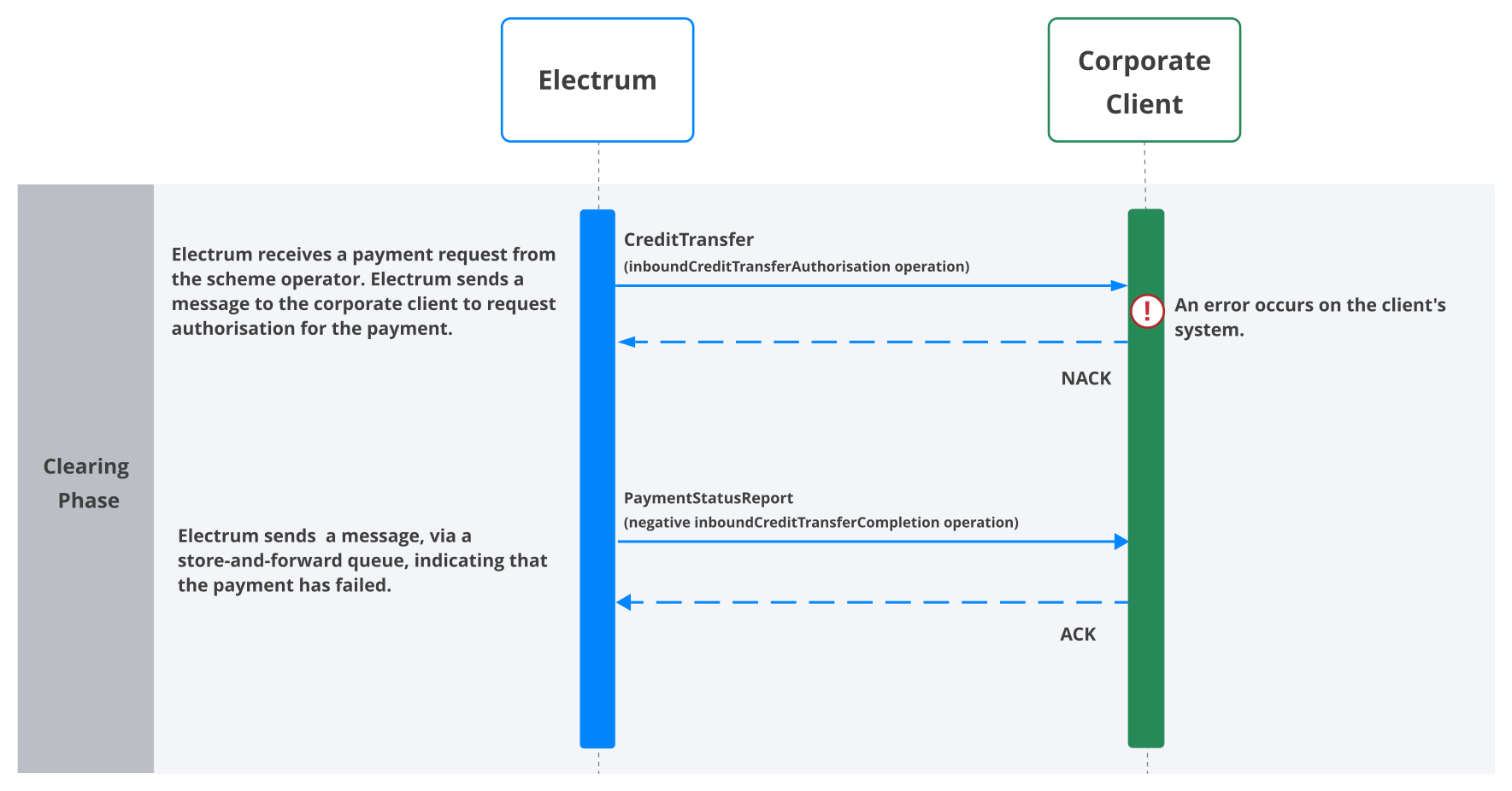
Negative Outcome
If you are able to process the authorisation request, but the result is negative, then respond with inboundCreditTransferAuthorisationResponse message (PaymentStatusReport schema) that includes appropriate values for status.outcome and status.reasonInfo.reason. The table below indicates the possible status.reasonInfo.reason values in different scenarios. Electrum will respond to the scheme that the transaction was unsuccessful. No further action from you is required.
| Scenario | status.reasonInfo.reason Value and Description |
|---|---|
| A given proxy is no longer valid at the time of clearing. | AG01 (Transaction Forbidden) |
| The payment is related to an RTP that is no longer valid. | AG01 (Transaction Forbidden) |
| The account or wallet linked to a given proxy is blocked, closed, or non-compliant. |
|
| The transaction is not allowed for the account linked to a given proxy. | AG01 (Transaction Forbidden) |
| Invalid or incorrect payment amount. | AM12 (Invalid Amount) |
| Error at corporate client. |
|
| Technical errors relating to the transaction message. |
|
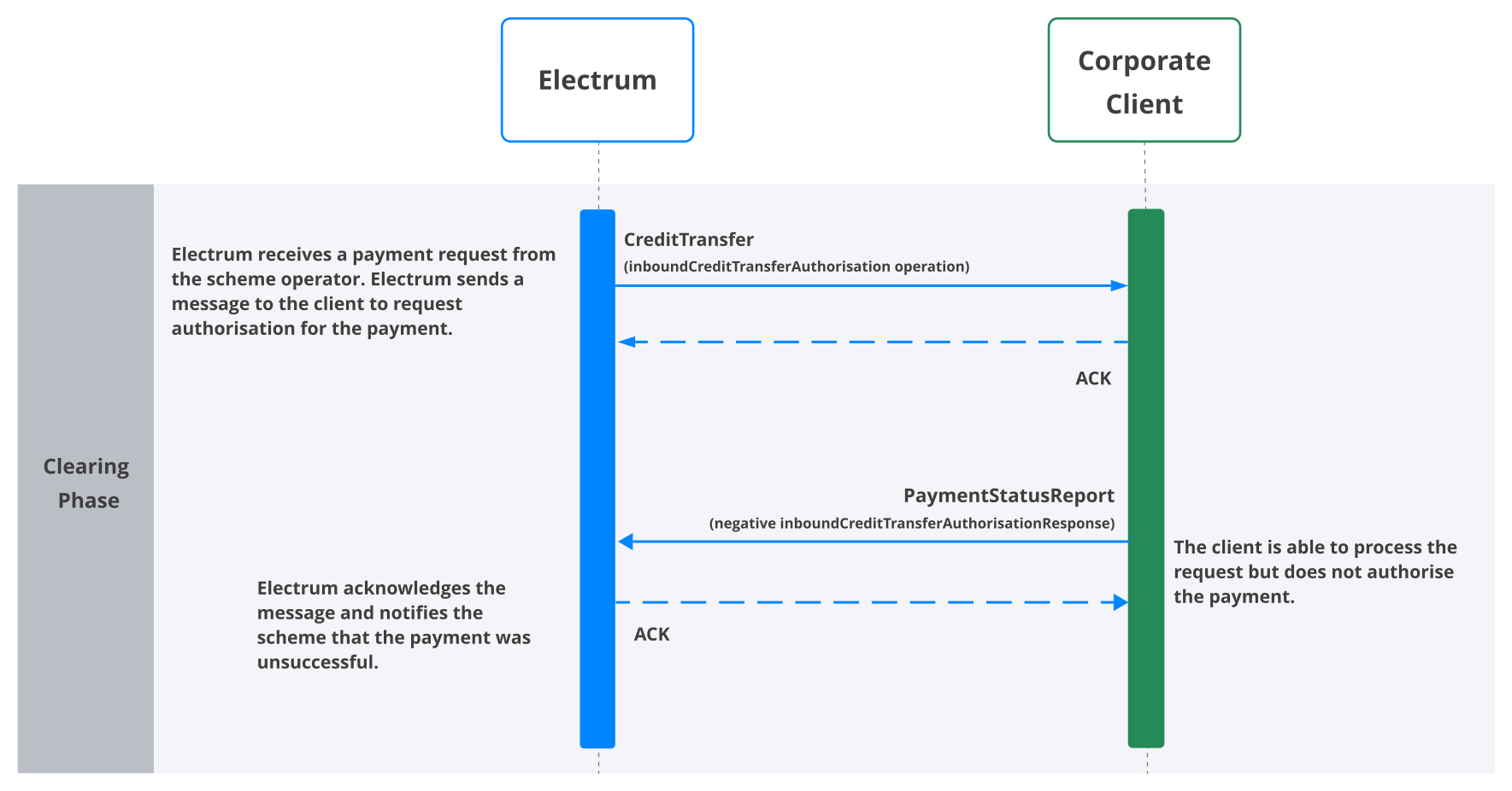
Timeout at Electrum
If Electrum does not receive an inboundCreditTransferAuthorisationResponse from you within the appropriate time limit then Electrum will respond to the scheme that the transaction was unsuccessful. Your system will receive an inboundCreditTransferCompletion message (PaymentStatusReport schema) with a status code of REJECTED or CANCELLED, to inform you of the attempted payment that has failed. Electrum will send the message to you repeatedly via a store-and-forward (SAF) queue until you acknowledge receipt with an HTTP response.
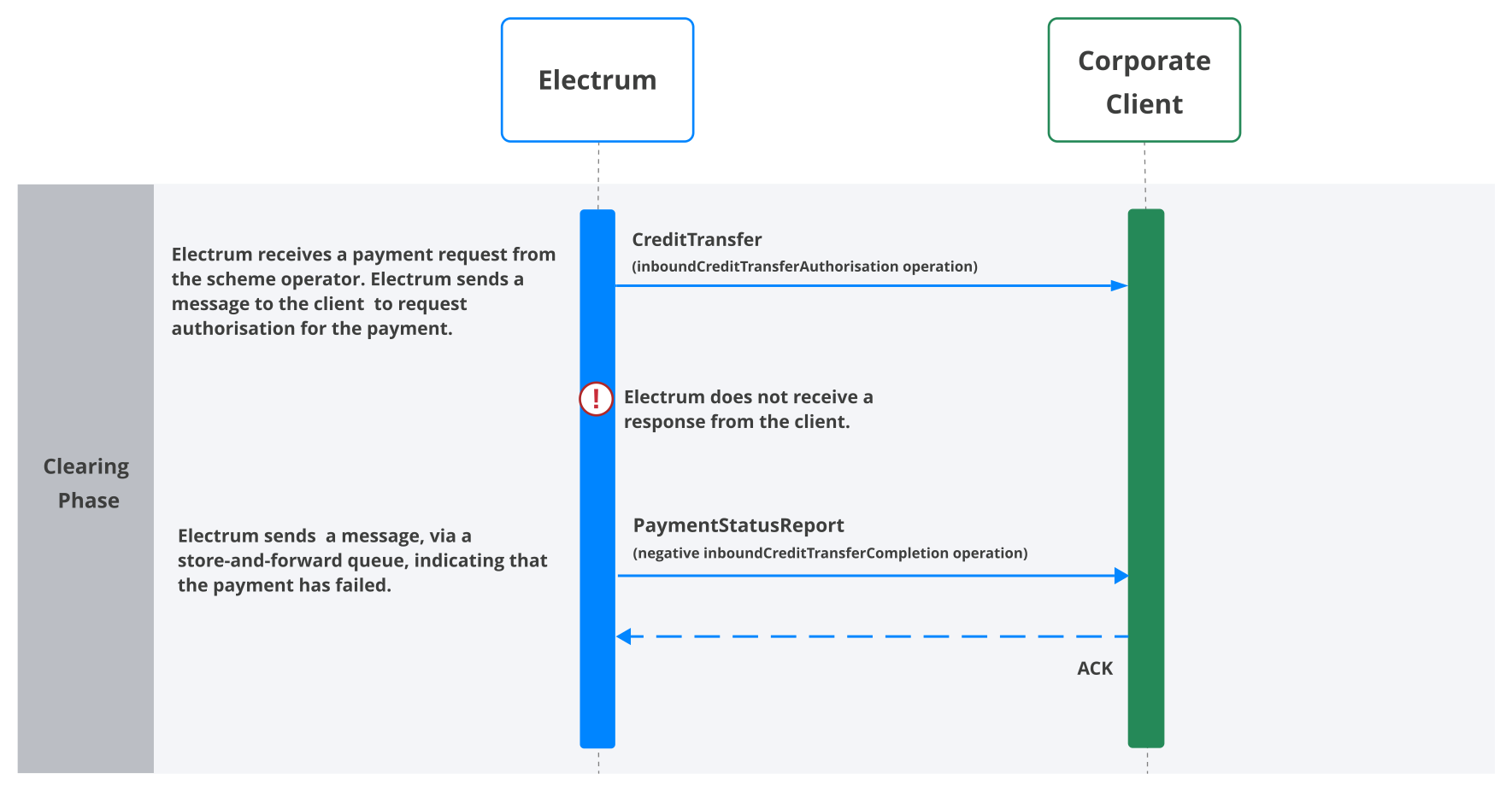
Error at Electrum
If Electrum experiences a technical error and is unable to process the inboundCreditTransferAuthorisationResponse message, then we will respond to you with an appropriate failure response as described in the Error Handling and Failure Responses section. Electrum will respond to the scheme that the transaction was unsuccessful. Your system will receive an inboundCreditTransferCompletion message (PaymentStatusReport schema) with a status code of REJECTED or CANCELLED, to inform you that the attempted payment has failed. Electrum will send the inboundCreditTransferCompletion to you repeatedly via a store-and-forward (SAF) queue until you return an HTTP response to acknowledge receipt.
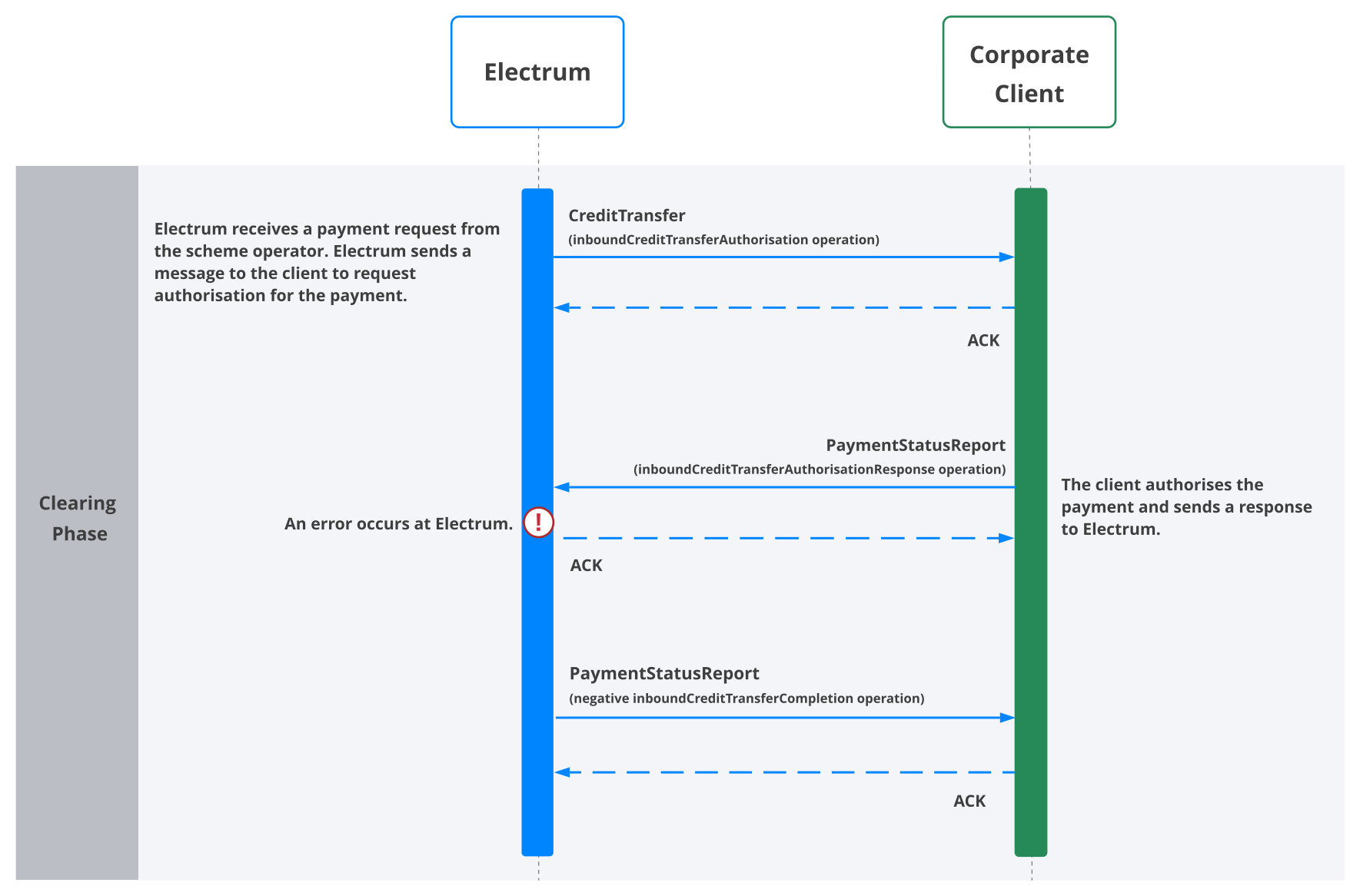
Although your initial outcome in the inboundCreditTransferAuthorisationResponse message (PaymentStatusReport schema) may have been APPROVED, the final outcome in the inboundCreditTransferCompletion message (PaymentStatusReport schema) may be REJECTED or CANCELLED. It is therefore important that you do not update your own customer records to reflect a payment based on your outcome of the authorisation step, but that you wait for the completion notification from Electrum with the final payment outcome.
Payment Finalisation
After the clearing of an inbound payment has been completed (either successfully or unsuccessfully) at the sponsor bank, Electrum will send an inboundCreditTransferCompletion request to you to notify you of the payment. At this point you can update your own systems to reflect the payment.
- Electrum sends you an
inboundCreditTransferCompletionmessage, conforming to thePaymentStatusReportschema, that includes astatus.outcomefield with the final outcome of the payment.
PaymentStatusReport Schema
Holds a point-to-point unique message identification string as well as a message's creation date time.
The date and time at which the message was created, in senders local timezone or UTC. The date must be formatted as defined by date-time in RFC3339
A reference used to unambiguously identify the message between the sending and receiving party. Take note that this uniquely identifies a single message in a potentially multi-message exchange to complete a payment.
A list of key-value pairs to support adding any supplementary/additional data to an Electrum Regulated Payments API message.
Holds a point-to-point unique message identification string as well as a message's creation date time.
The date and time at which the message was created, in senders local timezone or UTC. The date must be formatted as defined by date-time in RFC3339
A reference used to unambiguously identify the message between the sending and receiving party. Take note that this uniquely identifies a single message in a potentially multi-message exchange to complete a payment.
Holds a series of identifiers to identify the transaction or an individual message that is part of a transaction.
Unique identification, as assigned by the initiating party, to unambiguously identify the transaction. This identification is passed on, unchanged, throughout the entire end-to-end chain. Note: this is distinct from the UETR.
Unique identification, as assigned by an instructing party for an instructed party, to unambiguously identify the instruction. The instruction identification is a point to point reference that can be used between the instructing party and the instructed party to refer to the individual instruction. It can be included in several messages related to the instruction.
Unique identification, as assigned by the first instructing agent, to unambiguously identify the transaction that is passed on, unchanged, throughout the entire interbank chain. Usage: The transaction identification can be used for reconciliation, tracking or to link tasks relating to the transaction on the interbank level. Usage: The instructing agent has to make sure that the transaction identification is unique for a pre-agreed period.
Universally unique identifier to provide an end-to-end reference of a payment transaction. This identifier remains the same for all messages related to the same transaction.
APPROVED: The instruction has been approved.CANCELLED: The instruction has been cancelled.PENDING: The instruction is pending.REJECTED: The instruction has been rejected.PARTIALLY_ACCEPTED: Some, but not all, of the transactions in the group were accepted.
A list of StatusReasonInfo values providing detailed reason information for the outcome.
Provides a reference to the direct debit mandate signed between the creditor and the debtor.
Note: This model is not relevant to the ZA_EFT scheme. Electrum will not process these fields for EFT payments (e.g. tracking days are not honoured for EFT).
Contains key elements related to the original transaction that is being referred to.
Designates which scheme a payment status report is associated with and describes scheme-specific information for the payment status report.
- CBPR_PLUS
- TCIB
- ZA_AC
- ZA_EFT
- ZA_RPP
- ZA_RTC
Example
Cannot find OpeAPI operation by operationId or pointer
- You respond with an acknowledgement (ACK) in the form of an HTTP
2xxstatus code with no additional content.
Error Handling
No Response from Corporate Client
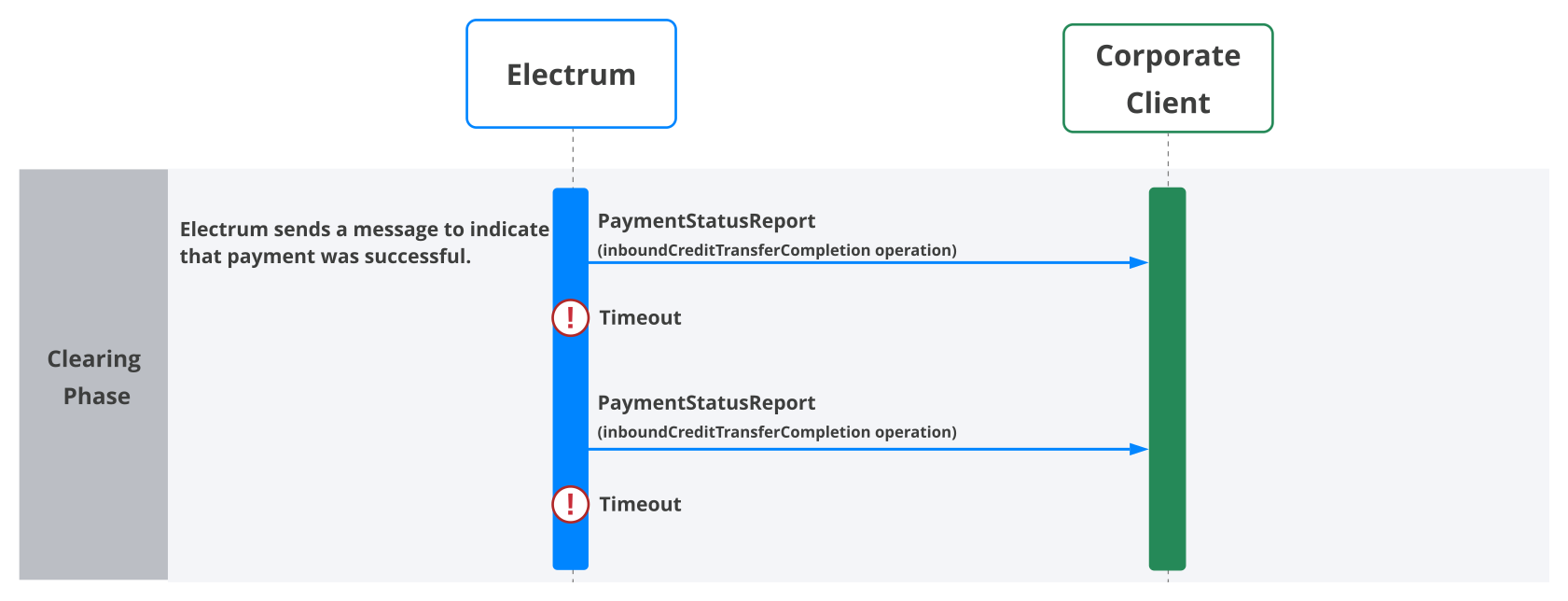
Electrum treats the inboundCreditTransferCompletion as a must-deliver message and will repeatedly send it to you via a store-and-forward (SAF) queue until you acknowledge receipt with an HTTP response.
If your solution includes the use of Electrum Finance for transaction reconciliation and Electrum does not receive an acknowledgement before the reconciliation window closes, the inboundCreditTransferCompletion transaction will be considered a reconciliation exception. The Electrum daily mark-off extract may contain a transaction which was not seen by your system, and subsequently was not included in your daily mark-off extract.
Electrum sends an inboundCreditTransferCompletion to you even if the inbound payment was unsuccessful. Refer to the status.outcome field to determine whether or not funds should be credited.
In rare circumstances, Electrum may be unable to determine the final state of the transaction from the payment network. In this case you will not receive an inboundCreditTransferCompletion and no action is required from you. Any discrepancy between your view of the transaction and that of the sending participant will need to be resolved during reconciliation.
Testing Your Implementation
Follow the testing procedure described here to make sure you have implemented the functionality correctly.