Send Request-To-Pay (RTP Accepted)
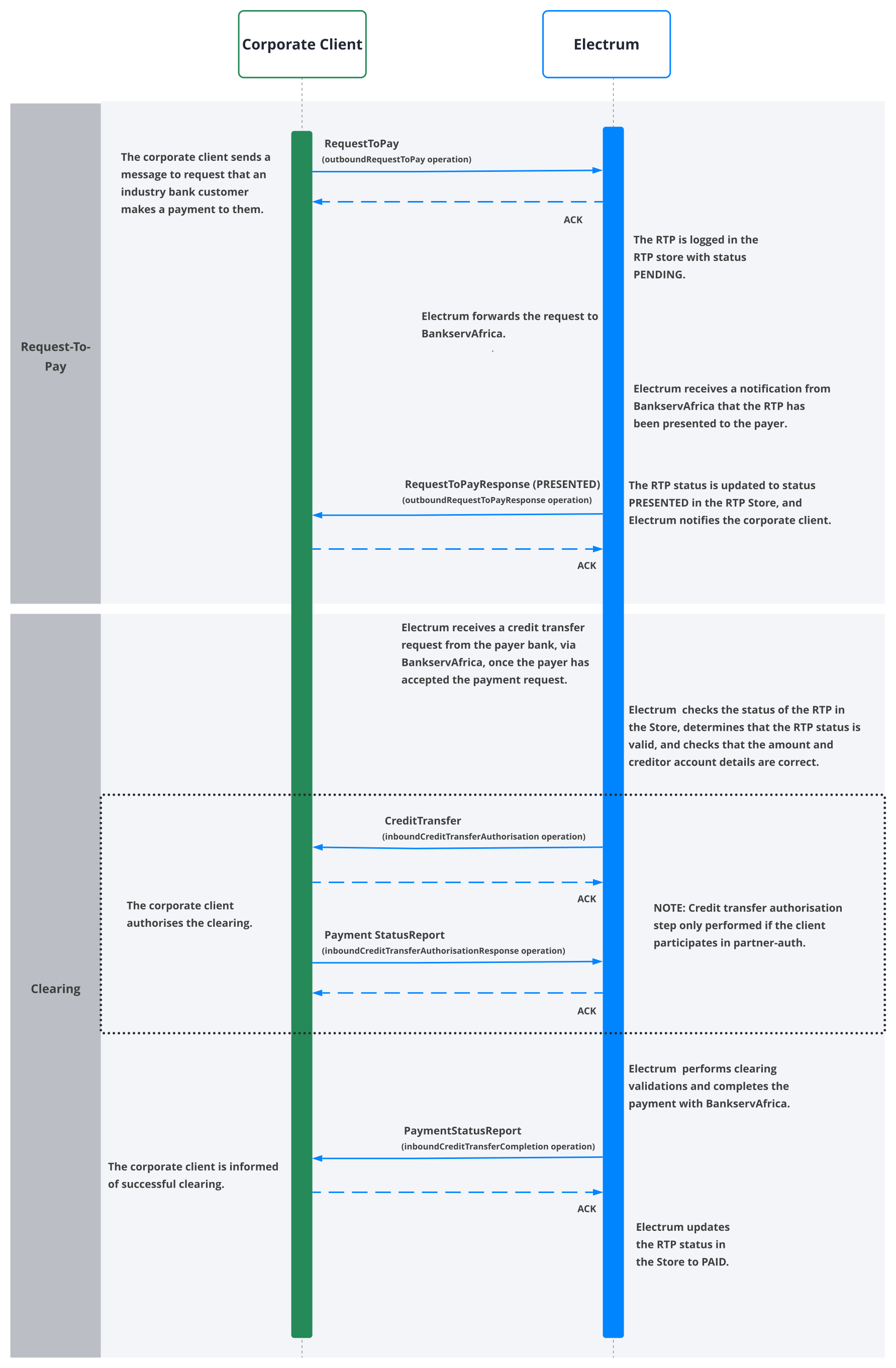
The following diagram shows a success scenario in which the corporate client requests payment from a payer at an industry bank, and the payer accepts the request.
The RTP status will change as the transaction progresses. This status is stored and updated in the RTP Store at Electrum.
The corporate client submits an outbound request-to-pay (the request is sent outwards from corporate client to industry) in order to initiate an inbound payment (payment is received inward to corporate client from industry).
See the RTP test pack for message samples pertaining to the operations described below. Download the RTP pack from this page.
- A payee at your institution sends an
outboundRequestToPayrequest message (RequestToPayschema) to initiate an RTP. You will also provide the following in the RTP request:
Creditor (payee) domain (Electrum populates the merchant account number).
Creditor (payee) known-as name.
Creditor proxy details in the case of a proxy-based payment, or the account details in the case of an account-based payment.
RTP expiration date.
Requested amount, and whether amount modification is allowed.
Ultimate creditor. This field identifies the true end beneficiary/receiver of the funds - that is, the party that is ultimately entitled to receive the money, even if the payment is routed through intermediaries or credited to another account first.
Amount modification is ‘allowed’ if the requestToPayConditions.maxAmount is greater than the requestToPayConditions.minAmount. Amount modification is 'not allowed’ if the requestToPayConditions.maxAmount is equal to the requestToPayConditions.minAmount.
RequestToPay Schema
Holds a point-to-point unique message identification string as well as a message's creation date time.
The date and time at which the message was created, in senders local timezone or UTC. The date must be formatted as defined by date-time in RFC3339
A reference used to unambiguously identify the message between the sending and receiving party. Take note that this uniquely identifies a single message in a potentially multi-message exchange to complete a payment.
A list of key-value pairs to support adding any supplementary/additional data to an Electrum Regulated Payments API message.
Holds a series of identifiers to identify the transaction or an individual message that is part of a transaction.
Unique identification, as assigned by the initiating party, to unambiguously identify the transaction. This identification is passed on, unchanged, throughout the entire end-to-end chain. Note: this is distinct from the UETR.
Unique identification, as assigned by an instructing party for an instructed party, to unambiguously identify the instruction. The instruction identification is a point to point reference that can be used between the instructing party and the instructed party to refer to the individual instruction. It can be included in several messages related to the instruction.
Unique identification, as assigned by the first instructing agent, to unambiguously identify the transaction that is passed on, unchanged, throughout the entire interbank chain. Usage: The transaction identification can be used for reconciliation, tracking or to link tasks relating to the transaction on the interbank level. Usage: The instructing agent has to make sure that the transaction identification is unique for a pre-agreed period.
Universally unique identifier to provide an end-to-end reference of a payment transaction. This identifier remains the same for all messages related to the same transaction.
This model is the basic representation of a Party. It is expanded on depending on whether the party is a person or an organisation.
A code to identify a country, a dependency, or another area of particular geopolitical interest, on the basis of country names obtained from the United Nations (ISO 3166, Alpha-2 code).
The identification of a party, either a person or an organisation.
The name by which this party is commonly known in day to day use. For example, a shortening of their legal name or a nickname that they commonly use. This is "non-official". However, it is acceptable for this field to be set to the same as legalName.
The legal name by which this party is known (the "FICA" name). This is the full name of the party as found on country-issued documentation (national identity, company registration documentation etc).
Representation of an account for payment purposes. Note that at least one of identification or proxy is expected to be present.
Identification of the currency in which the account is held.
Name of the account, as assigned by the account servicing institution, in agreement with the account owner in order to provide an additional means of identification of the account.
A code allocated to a financial or non-financial institution by the ISO 9362 Registration Authority as described in ISO 9362 Banking - Banking telecommunication messages - Business identifier code (BIC)
An organisation identified by a code allocated to a party as described in ISO 17442 Financial Services - Legal Entity Identifier (LEI).
Name by which an institution is known and which is usually used to identify that institution
A unique identifier assigned to a company or organisation by a duly appointed authority within a country.
Deprecated. Please use the preferred clearingSystemMemberId.memberId instead. Identification of a member of a clearing system.
This model is the basic representation of a Party. It is expanded on depending on whether the party is a person or an organisation.
Representation of an account for payment purposes. Note that at least one of identification or proxy is expected to be present.
Identification of the currency in which the account is held.
Name of the account, as assigned by the account servicing institution, in agreement with the account owner in order to provide an additional means of identification of the account.
Date and time at which the request to pay expires. Some schemes may still permit a payment after the request to pay expires. Upon expiry, the following schemes will reject an associated payment: ZA_RPP. The date must be formatted as defined by date-time in RFC3339
Further information related to the processing of the payment instruction, provided by the initiating party, and intended for the debtor agent.
Agents between the debtor's agent and the creditor's agent. Usage: If more than one intermediary agent is present, then IntermediaryAgent1 identifies the agent between the DebtorAgent and the IntermediaryAgent2
Designates which scheme a customer credit transfer is associated with and describes scheme-specific information for the credit transfer.
Information necessary for FI to FI customer credit transfers, specifically for CBPR+
DEBT(BorneByDebtor): All transaction charges are to be borne by the debtorCRED(BorneByCreditor): All transaction charges are to be borne by the creditorSHAR(Shared): In a credit transfer context, means that transaction charges on the sender side are to be borne by the debtor, transaction charges on the receiver side are to be borne by the creditor. In a direct debit context, means that transaction charges on the sender side are to be borne by the creditor, transaction charges on the receiver side are to be borne by the debtor.SLEV(FollowingServiceLevel): Charges are to be applied following the rules agreed in the service level and/or scheme
Factor used to convert an amount from one currency into another. This reflects the price at which one currency was bought with another currency.
Agent(s) between the debtor's agent and the instructing agent.
Specifies the underlying reason for the payment transaction
Describes the various aspects of a request to pay which must be accepted or to what extent they may be altered.
A valid, active currency code as defined in ISO 4217 indicating the currency of the amount.
The payment amount in the denomination of the indicated currency, in the format '<major units>.<minor units> with the number of minor units (fractional digits) compliant with the number of decimal places published in ISO 4217.
| Currency Code | Example | Valid | Notes |
|---|---|---|---|
| USD | 10.0 | ✓ | Represents 10 USD and no cents. |
| USD | 10.00 | ✓ | |
| USD | 10.001 | ✗ | US dollar does not support three decimal places. |
| JPY | 10.0 | ✓ | Represents 10 Japanese Yen. |
| JPY | 10.1 | ✗ | Japanese Yen does not support decimal places. |
A valid, active currency code as defined in ISO 4217 indicating the currency of the amount.
The payment amount in the denomination of the indicated currency, in the format '<major units>.<minor units> with the number of minor units (fractional digits) compliant with the number of decimal places published in ISO 4217.
| Currency Code | Example | Valid | Notes |
|---|---|---|---|
| USD | 10.0 | ✓ | Represents 10 USD and no cents. |
| USD | 10.00 | ✓ | |
| USD | 10.001 | ✗ | US dollar does not support three decimal places. |
| JPY | 10.0 | ✓ | Represents 10 Japanese Yen. |
| JPY | 10.1 | ✗ | Japanese Yen does not support decimal places. |
This model is the basic representation of a Party. It is expanded on depending on whether the party is a person or an organisation.
This model is the basic representation of a Party. It is expanded on depending on whether the party is a person or an organisation.
Example
No contentElectrum returns an acknowledgement (ACK, HTTP
202) to you.Electrum logs the RTP, with a status of
PENDING, in the RTP Store.Electrum forwards the request to BankservAfrica.
BankservAfrica notifies Electrum once the RTP has been presented to the payer.
Electrum sends an
outboundRequestToPayResponsemessage (RequestToPayResponseschema) with a status code of PRESENTED to you. You return an acknowledgement (ACK, HTTP202).
A status of PRESENTED does not mean that the payment will necessarily be made. It means only that the bank receiving the RTP has presented it to their customer, the payer. The payer must still choose to accept or decline the payment.
RequestToPayResponse Schema
Holds a point-to-point unique message identification string as well as a message's creation date time.
The date and time at which the message was created, in senders local timezone or UTC. The date must be formatted as defined by date-time in RFC3339
A reference used to unambiguously identify the message between the sending and receiving party. Take note that this uniquely identifies a single message in a potentially multi-message exchange to complete a payment.
A list of key-value pairs to support adding any supplementary/additional data to an Electrum Regulated Payments API message.
Holds a point-to-point unique message identification string as well as a message's creation date time.
The date and time at which the message was created, in senders local timezone or UTC. The date must be formatted as defined by date-time in RFC3339
A reference used to unambiguously identify the message between the sending and receiving party. Take note that this uniquely identifies a single message in a potentially multi-message exchange to complete a payment.
Holds a series of identifiers to identify the transaction or an individual message that is part of a transaction.
Unique identification, as assigned by the initiating party, to unambiguously identify the transaction. This identification is passed on, unchanged, throughout the entire end-to-end chain. Note: this is distinct from the UETR.
Unique identification, as assigned by an instructing party for an instructed party, to unambiguously identify the instruction. The instruction identification is a point to point reference that can be used between the instructing party and the instructed party to refer to the individual instruction. It can be included in several messages related to the instruction.
Unique identification, as assigned by the first instructing agent, to unambiguously identify the transaction that is passed on, unchanged, throughout the entire interbank chain. Usage: The transaction identification can be used for reconciliation, tracking or to link tasks relating to the transaction on the interbank level. Usage: The instructing agent has to make sure that the transaction identification is unique for a pre-agreed period.
Universally unique identifier to provide an end-to-end reference of a payment transaction. This identifier remains the same for all messages related to the same transaction.
Contains key elements related to the original request to pay that is being referred to.
Describes the various aspects of a request to pay which must be accepted or to what extent they may be altered.
A list of RequestToPayStatusReasonInfo values providing detailed reason information for the status.
PAID: Paid - The request to pay was approved by the debtor and the payment has been processed. Note that the outcome of the payment itself is not communicated.ACCEPTED: Accepted - The request to pay was approved by the debtor but the payment has not yet been processed.CANCELLED: Cancelled - Request to pay has been successfully cancelled after having received a request for cancellation.EXPIRED: Expired - The request to pay has expired.PENDING: Pending - The request to pay has been forwarded and an initial status report is still expected.PRESENTED: Presented - The request to pay has been accepted by the payer participant and will be presented to the debtor.REJECTED: Rejected - The request to pay has been rejected.REFUND_IN_PROGRESS: Refund in progress - The refund of the original request to pay is currently in progress and does not yet have an outcomeREFUNDED: Refunded - The refund of the original request to pay has been completed successfully
Example
No contentElectrum updates the status in the RTP Store to
PRESENTED.The payer at the industry bank accepts the request-to-pay and the industry bank initiates the payment. BankservAfrica sends the credit transfer request to Electrum.
Electrum retrieves the RTP status from the Store and determines that it is valid by:
Confirming the RTP exists and the status is either
PENDINGorPRESENTED, and is notCANCELLED,REJECTED,EXPIRED, orPAID. Note: the payment will still be accepted in the case that the RTP status isPENDINGin the RTP store. For instance, in cases where theoutboundRequestToPayResponse (PRESENTED)message has gotten lost, or there was a timeout, or the payer paid very soon after receiving the RTP, before theoutboundRequestToPayResponse (PRESENTED)could reach the RTP store.When amount modification is not allowed, checking that the amount sent by the payer matches that of the amount requested in the original request.
When amount modification is allowed, checking that the amount sent by the payer is within the maximum and minimum requested amount.
Confirming that the creditor account number or proxy and domain belong to a listed corporate client.
If your institution participates in partner-authorisation, this additional clearing authorisation step will occur: Electrum sends an
inboundCreditTransferAuthorisationrequest to you, and you acknowledge with an ACK HTTP202. You send Electrum a positiveinboundCreditTransferAuthorisationResponsemessage when the validations pass, and Electrum returns a positive acknowledgement.Electrum sends an
inboundCreditTransferCompletionmessage (PaymentStatusReportschema) message to you to indicate clearing completion, and updates the RTP status toPAID. Electrum communicates with the sponsor bank and sends a posting instructing the sponsor bank to credit your account with the paid amount.
PaymentStatusReport Schema
Holds a point-to-point unique message identification string as well as a message's creation date time.
The date and time at which the message was created, in senders local timezone or UTC. The date must be formatted as defined by date-time in RFC3339
A reference used to unambiguously identify the message between the sending and receiving party. Take note that this uniquely identifies a single message in a potentially multi-message exchange to complete a payment.
A list of key-value pairs to support adding any supplementary/additional data to an Electrum Regulated Payments API message.
Holds a point-to-point unique message identification string as well as a message's creation date time.
The date and time at which the message was created, in senders local timezone or UTC. The date must be formatted as defined by date-time in RFC3339
A reference used to unambiguously identify the message between the sending and receiving party. Take note that this uniquely identifies a single message in a potentially multi-message exchange to complete a payment.
Holds a series of identifiers to identify the transaction or an individual message that is part of a transaction.
Unique identification, as assigned by the initiating party, to unambiguously identify the transaction. This identification is passed on, unchanged, throughout the entire end-to-end chain. Note: this is distinct from the UETR.
Unique identification, as assigned by an instructing party for an instructed party, to unambiguously identify the instruction. The instruction identification is a point to point reference that can be used between the instructing party and the instructed party to refer to the individual instruction. It can be included in several messages related to the instruction.
Unique identification, as assigned by the first instructing agent, to unambiguously identify the transaction that is passed on, unchanged, throughout the entire interbank chain. Usage: The transaction identification can be used for reconciliation, tracking or to link tasks relating to the transaction on the interbank level. Usage: The instructing agent has to make sure that the transaction identification is unique for a pre-agreed period.
Universally unique identifier to provide an end-to-end reference of a payment transaction. This identifier remains the same for all messages related to the same transaction.
APPROVED: The instruction has been approved.CANCELLED: The instruction has been cancelled.PENDING: The instruction is pending.REJECTED: The instruction has been rejected.PARTIALLY_ACCEPTED: Some, but not all, of the transactions in the group were accepted.
A list of StatusReasonInfo values providing detailed reason information for the outcome.
Provides a reference to the direct debit mandate signed between the creditor and the debtor.
Note: This model is not relevant to the ZA_EFT scheme. Electrum will not process these fields for EFT payments (e.g. tracking days are not honoured for EFT).
Contains key elements related to the original transaction that is being referred to.
Designates which scheme a payment status report is associated with and describes scheme-specific information for the payment status report.
- CBPR_PLUS
- TCIB
- ZA_AC
- ZA_EFT
- ZA_RPP
- ZA_RTC
You can request the status of an RTP from the RTP Store at any time for any reason. You can do this as part of an error scenario (when you have not received an expected RequestToPayResponse message from Electrum), or simply for informational purposes.
Retrieve the RTP status by sending a synchronous getRequestToPayWithPOST request directly to the Store.
Error Handling
BankservAfrica Cancels the RTP
If BankservAfrica cancels the RTP from their side (e.g., due to a timeout) then they will notify Electrum. Electrum will send an outboundRequestToPayResponse message (RequestToPayResponse schema), containing a status of REJECTED to you and to the RTP Store, where the RTP status will be updated to REJECTED.
No Response from Electrum
If you do not receive an outboundRequestToPayResponse from Electrum within a set time period, a timeout will occur. You may send ad-hoc status requests by sending a getRequestToPayWithPOST message (RequestToPayStatusRequest schema) to the RTP Store. The Store will return a message (RequestToPayResponse schema) with the latest RTP status.
No Acknowledgement from Corporate Client
If Electrum does not receive an acknowledgment from you in response to an outboundRequestToPayResponse, then Electrum will continue to send the message up to a total of three times, or until you return an HTTP 202 response, before stopping.
Errors at Corporate Client
If an error or failure occurs on your system after Electrum has sent an outboundRequestToPayResponse, then you will return a negative acknowledgement (NACK). Electrum will continue to send the message to try and inform you of the RTP status. If you still do not receive the status message, then you can query the RTP status by sending a getRequestToPayWithPOST request to the RTP Store.
RTP Expires
If the RTP expires before the payment is made, then the RTP status will be updated to EXPIRED in the RTP Store. The Store forwards an outboundRequestToPayResponse message (RequestToPayResponse schema, status EXPIRED) to you to inform you of the expiration. You can choose to initiate a new request-to-pay.
Non-valid RTP Status During Clearing
During the clearing leg of the payment, the Electrum Store may return an RTP status of EXPIRED, CANCELLED, REJECTED, or PAID. In that case Electrum will send a negative inboundCreditTransferCompletion (PaymentStatusReport schema) indicating that the payment was unsuccessful and detailing the reasons.
Testing Your Implementation
Follow the testing procedure described here to make sure you have implemented the functionality correctly.